Cordyceps for Running and Endurance: What the Research Shows
Share
Cordyceps is a medicinal mushroom that has been studied for endurance because of its traditional use for energy and stamina, but the research on runners and cyclists is small and mixed. A few trials found modest improvements in oxygen use or time to exhaustion, especially in older or untrained people, while studies in trained cyclists found no benefit. If you are training for Comrades, Two Oceans or your next parkrun, sleep, carbohydrates and iron status will make a far bigger difference than any supplement.
Walk through any running expo in South Africa and you will see mushroom coffees, powders and gummies promising "more oxygen" and "natural endurance". Cordyceps is usually the star ingredient. So what does the research actually say, and where should it sit on a runner's list of priorities?
What is cordyceps?
Cordyceps is a group of fungi used for centuries in traditional Chinese and Tibetan medicine, where it was valued for energy, stamina and recovery. The two types you will see in supplements are:
- Cordyceps sinensis (now Ophiocordyceps sinensis): the wild form grows on caterpillar larvae high on the Tibetan Plateau and is extremely expensive. Supplements labelled "sinensis" are usually made from cultivated mycelium, such as the fermented strain known as Cs-4.
- Cordyceps militaris: a related species that is easier to grow and is now common in supplements and mushroom blends.
Lab and animal research suggests cordyceps compounds (such as cordycepin and adenosine) may influence energy metabolism and oxygen use, which is why sport scientists became interested. But results in animals do not always carry over to people.
Cordyceps and endurance: what the human trials show
| Study | Who and what | Result |
|---|---|---|
| Parcell et al., 2004 | 22 trained male cyclists, Cs-4 (CordyMax) 3 g a day for 5 weeks | No improvement in VO2 peak, ventilatory threshold or time-trial performance. |
| Colson et al., 2005 | 8 male cyclists, cordyceps plus rhodiola formula | No differences in VO2max, ventilatory threshold or time to exhaustion. |
| Chen et al., 2010 | 20 healthy adults aged 50 to 75, Cs-4 333 mg three times a day for 12 weeks | Metabolic threshold rose 10.5% and ventilatory threshold 8.5%; VO2max did not change. |
| Chen et al., 2014 | 18 men during 2 weeks of altitude training (2,200 m), rhodiola plus cordyceps | Run time to exhaustion improved 5.7% vs 2.2% with placebo. |
| Hirsch et al., 2017 | 28 young adults, mushroom blend containing C. militaris, 4 g a day | No change after 1 week. After 3 weeks (10 people continued), VO2max and time to exhaustion improved compared with placebo. |
| Tsuk et al., 2018 | 96 physical education students, cordyceps plus reishi, about 4 weeks | No effect on VO2max or peak exercise responses. |
| Farzan et al., 2026 | 12 active young men, single 1 g dose of C. militaris extract | Higher resting oxygen uptake and slightly faster reaction times after exercise; peak VO2 unchanged. |
How to read these results
- The trials are small. Most had fewer than 30 people, and some tested blends, so it is hard to know what cordyceps itself contributed.
- Trained athletes saw little or no effect. The positive signals came mostly from older adults, untrained or recreationally active people, or altitude training.
- Species and dose differ. Results for Cs-4 at 3 g a day do not automatically apply to C. militaris or to other extracts and doses.
- No race-performance data. No trial has tested whether cordyceps improves a marathon, ultra or 5 km time.
Overall, cordyceps has been studied for exercise capacity with mixed results. It is reasonable to call it "promising but unproven".
What matters more for runners
If you are building up to Comrades or Two Oceans, or chasing a parkrun PB, these basics have much stronger evidence than any mushroom.
1. Sleep
Your body adapts to training while you recover, and much of that happens during sleep. Poor sleep makes runs feel harder and raises injury risk. Aim for a consistent bedtime, especially in heavy training blocks, and be careful with late caffeine. Our guide to natural sleep support has practical tips.
2. Carbohydrates
Carbohydrates fuel endurance running by keeping blood sugar up and refilling muscle glycogen. The NIH Office of Dietary Supplements notes that athletes typically need 3 to 10 g of carbohydrate per kg of body weight a day, depending on training load. Long runs and race day also call for fuelling during the run. Practise your race-day fuel in training, never on the day.
3. Iron
Iron carries oxygen in your blood, so low iron can make you feel flat and slow. Runners are at higher risk because iron is lost in sweat and through "foot-strike haemolysis" (red blood cells broken down by repeated impact), and regular use of anti-inflammatory painkillers can cause small amounts of gut blood loss. Women who menstruate are at greater risk. People on vegetarian diets need about 1.8 times more iron because plant iron is less easily absorbed. If you are always tired, ask your doctor for a blood test that includes ferritin before taking iron, because too much iron is harmful.
4. Training structure
Most endurance gains come from consistent easy running, a gradual increase in weekly distance, some faster sessions and planned rest weeks. No supplement replaces that.
Is cordyceps safe? Who should avoid it
Cordyceps appears to be generally well tolerated in short-term studies, but there is limited long-term safety data. Memorial Sloan Kettering Cancer Center highlights several cautions:
- Blood thinners: lab research suggests cordyceps may reduce platelet clumping, and a case of excessive bleeding after a dental extraction has been linked to it. Avoid it if you take warfarin, aspirin, clopidogrel or similar medicines, and stop before surgery or dental procedures.
- Diabetes medicines: it may add to blood-sugar-lowering effects.
- Immunosuppressants and autoimmune conditions: cordyceps may affect the immune system, so speak to your doctor if you have an autoimmune condition (such as lupus, rheumatoid arthritis or MS) or take immune-suppressing medicine.
- Certain blood cancers: MSKCC advises against it for people with myelogenous-type cancers.
- Pregnancy and breastfeeding: there is no safety data, so avoid it.
If you compete at a level where you are drug tested, remember that any supplement can be contaminated. Use products with batch testing for banned substances and check with your federation.
See a doctor if…
- You feel unusually tired, breathless or dizzy on runs that used to be easy (this can be a sign of low iron, overtraining or a heart problem)
- You get chest pain, palpitations or fainting during or after exercise: stop running and get checked urgently; call 112 or 10177 in an emergency
- You bruise easily, have nosebleeds or unusual bleeding, especially if you take blood thinners
- You have lost your period for three months or more while training hard
Where Elevate fits
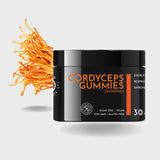
Our Cordyceps Gummies contain 1000mg cordyceps extract (labelled Cordyceps sinensis) per gummy, and cordyceps is one of ten mushrooms in our 10-in-1 Mushroom Complex Gummies. Cordyceps is traditionally used for energy and stamina and has been studied for exercise capacity with mixed results; the doses and extracts in trials differ from ours. Do not use them if you take blood thinners or have an autoimmune condition without speaking to your doctor first. See the full train collection, or read our cordyceps ingredient guide.
Frequently asked questions
Does cordyceps increase VO2max?
Some small studies found improvements, mainly in untrained people over three weeks, but other trials, including in trained cyclists, found no change. The evidence is mixed.
When should I take cordyceps before a run?
Most trials used daily doses for several weeks rather than a single pre-run dose, so there is no evidence-based "best time". If you use it, take it consistently with food.
Is cordyceps a stimulant like caffeine?
No. It does not contain caffeine, and research has not shown a stimulant-like effect.
Can I take cordyceps with creatine or other supplements?
There is no known interaction between cordyceps and creatine. Check with your pharmacist if you take any medicines. For more on creatine, read creatine gummies vs powder.
Is cordyceps banned in sport?
Cordyceps itself is not a banned substance, but contaminated supplements can cause positive tests. Tested athletes should use batch-tested products.
Sources
- Parcell AC, et al. Cordyceps sinensis (CordyMax Cs-4) supplementation does not improve endurance exercise performance. International Journal of Sport Nutrition and Exercise Metabolism, 2004. pubmed.ncbi.nlm.nih.gov/15118196
- Colson SN, et al. Cordyceps sinensis- and Rhodiola rosea-based supplementation in male cyclists and its effect on muscle tissue oxygen saturation. Journal of Strength and Conditioning Research, 2005. pubmed.ncbi.nlm.nih.gov/15903375
- Chen S, et al. Effect of Cs-4 (Cordyceps sinensis) on exercise performance in healthy older subjects: a double-blind, placebo-controlled trial. Journal of Alternative and Complementary Medicine, 2010. pubmed.ncbi.nlm.nih.gov/20804368
- Chen CY, et al. Rhodiola crenulata- and Cordyceps sinensis-based supplement boosts aerobic exercise performance after short-term high altitude training. High Altitude Medicine and Biology, 2014. pubmed.ncbi.nlm.nih.gov/25251930
- Hirsch KR, et al. Cordyceps militaris improves tolerance to high-intensity exercise after acute and chronic supplementation. Journal of Dietary Supplements, 2017. pubmed.ncbi.nlm.nih.gov/27408987
- Tsuk S, et al. Effects of a commercial supplement of Ophiocordyceps sinensis and Ganoderma lucidum on physiological responses to maximal exercise in healthy young participants. International Journal of Medicinal Mushrooms, 2018. pubmed.ncbi.nlm.nih.gov/29953396
- Farzan H, et al. Acute Cordyceps militaris supplementation and elevated resting oxygen uptake with faster reaction times. PLoS One, 2026. pubmed.ncbi.nlm.nih.gov/42455764
- Memorial Sloan Kettering Cancer Center. Cordyceps (About Herbs). mskcc.org
- NIH Office of Dietary Supplements. Dietary Supplements for Exercise and Athletic Performance: Fact Sheet for Health Professionals. ods.od.nih.gov
- NIH Office of Dietary Supplements. Iron: Fact Sheet for Health Professionals. ods.od.nih.gov
This article is for general information only and isn't medical advice. Elevate gummies are food supplements and are not intended to diagnose, treat, cure or prevent any disease. Speak to your doctor or pharmacist before starting any supplement, especially if you are pregnant, breastfeeding, taking medication or have a medical condition.